

Amy Hawthorne: Confessions of a former SEO copywriter
From keyword spreadsheets to brand voice architecture: how Amy Hawthorne rewired her process without a single shortcut.

In this week’s Copy THIS, I’m talking to the writers who feel stuck squeezing sentences out of half‑baked briefs. You’ll meet Amy Hawthorne, a former “keyword counter” who now treats research like an extreme sport - and refuses to let AI touch her first draft. If you’ve been secretly hoping there’s a shortcut… this one might annoy you (in a good way).
“If you’re squeezing every sentence out, you haven’t done enough research.”
That’s how Amy Hawthorne explains the moment she knows a project is in trouble.
It’s not when the deadline is close.
It’s not when the brief is vague (although this never helps).
It’s when every line of copy feels forced.
Because, for Amy, writer’s block is rarely a motivation or inspiration problem.
It’s a research problem.
A Liverpool-based copywriter who has lived in Australia and travelled across the globe, Amy Hawthorne has built the kind of career that is goals for a lot of copywriters:
7 years freelancing (and counting)
12+ years total in marketing and writing
A long-term retainer client she has worked with for 6 years
A roster of agencies, challenger brands and lifestyle companies who come to her when they want a voice with real personality, not “fun but approved by legal”
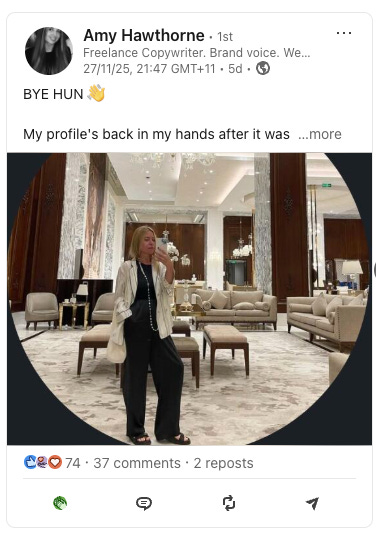
But if you scroll her LinkedIn (which was recently hacked, see screenshot below), you will not see her selling a 3-part repeatable system or codified framework.
Instead, you see what looks like the world’s most old-fashioned process:
Pen
Paper
Research
Ideas
Amy Hawthorne is Peggy Olson with Wi‑Fi.
Maximum attitude. Zero shortcuts.
Allow me to introduce you properly.
From “keyword counter” to brand voice architect
Much like Peggy, Amy didn’t start in glamorous brand voice land. She didn’t start as a receptionist either, but the work was just as dull.
SEO. Not the fun “strategy” kind.
The “keyword density spreadsheet open all day” kind.
“My job was basically counting keywords,” she told me.
No direct response.
No brand voice.
No killer taglines.
Just: here’s your list, get ’em in.
If you have ever crammed phrases into blog posts until they read like spam, you know the feeling.
That early work did something important, though. It made her hate shallow, algorithm‑focused writing.
She could feel the lack of originality. The lack of respect for readers. The way good writers were being used as human keyword‑stuffers instead of thinkers.
So as the industry shifted away from old‑school SEO, Amy shifted with it.
Today, she has no interest in being “the blog factory.”
She lives in the upstream work:
Brand voice workshops (2–3 hours on Zoom, sometimes full‑day sessions with teams)
Website copy and brand voice guides
Email marketing that feels one‑to‑one, not like soulless blasts
She’s not chasing every channel. She’s going deep on one thing: how a brand sounds when it actually knows who it is.
Inside Amy’s research rabbit holes
If you think “research” means “skim a few competitor sites and call it a day” (or worse, ask ChatGPT), Amy will ruin that for you.
Before she writes a single line, here is her process:
1. She interrogates
A detailed briefing form goes out first. If you’re not serious, you won’t get a call.
On the call, she asks “5 million questions” (her words, not mine).
She runs games and exercises to nail down tone, personality, adjectives, and what the brand is really about.
2. She goes analogue
Ideas start with pen and paper. Half‑formed phrases. Odd scraps.
This is the part where she lets her creativity surface. No polish.
3. She disappears down weird rabbit holes
For a US billboard company whose biggest challenge is getting people to look up from their phones, she watched scenes from Don’t Look Up with Leonardo DiCaprio and Jennifer Lawrence - the film where no one cares that a meteor is coming.
For a luxury events company, she dove into The Great Gatsby, as well as marketing that advertised or leaned on Paris as a vibe.
For niche clients (like damp‑proofing in Brighton), she raids Reddit threads to feel the actual frustration of people living with the problem.
Finally, everything goes into a spreadsheet
Tabs for USPs
Benefits
Competitors
Phrases
Tone cues
By the time Amy opens a doc, she already knows what she’s going to write.
“If you’re squeezing every sentence out, that’s when you know you haven’t done enough research.”
This is the opposite of “open Google Docs, type ‘Hey [FIRSTNAME],’ then ask ChatGPT or Gemini for 20 hooks.”
It’s slow.
It’s unsexy.
And it’s exactly why her work is as good as it is.
(If your drafts feel like a slog right now, this is the part of Amy’s process to steal first.)
Want the Loop-de-Scoop?
Better ways to look at copy and brand voice. Short emails, 3x a week. Sent in the morning, to start your day off gorgeously.
Why Amy’s “Black Hole” beats any swipe file
One of my favourite things Amy shared is how she captures ideas. She has notes on her phone called “The Black Hole.”
Into it goes:
Odd phrases she overhears
Lines from books that feel like a punch to the face
Random campaign ideas for real or sometimes imaginary brands
Anything that makes her think: wow, that’s good
Later, when she remembers, those fragments get transferred into a spreadsheet on her laptop.
None of this will surprise a writer. Most of us have a system for capturing random ideas and sources for inspiration. Mine is in Notion and it’s called the “Scratchpad.”
But what’s interesting about Amy’s is how she looks at it.
To Amy, it’s proof.
Proof that the work happens long before writing.
Proof that attention and curiosity beat “templates” and AI outputs every single time.
Everyone wants a ready‑made framework for success.
But if you ask Amy, you have to make your own framework from the random thoughts, ideas and snippets you encounter along the way.
Why Amy will not let AI write her first draft
We obviously couldn’t not talk about AI.
Amy’s not naive. She’s dabbled with AI. She knows there are plenty of writers already using it.
But we both agreed that each time you use it, there’s a risk.
A risk that you have lost a little bit of creativity.
A little bit of magic.
Especially if you’re a junior. Without doing the “hard yards” - training your creative muscle - you won’t learn how to write. You’ll only learn how to prompt.
Her advice is blunt:
Don’t use AI to “get started” on a draft.
Don’t ask it for angles, hooks or voice.
Because once you see something that looks okay on the surface, it’s bloody hard to deviate from it.
In a recent client book, she literally wrote:
“Everything needs to come straight from your brain. We believe in you.”
Not because AI is bad.
But because thinking is your asset.
This is an area we both shared different perspectives on. For Amy, her best writing starts with a blank page. In my case, I’ve always been more of an editor than a writer.
But what we both agreed on is simple:
You have to do the work.
There is no shortcut that can help you:
Hear a throwaway comment from a client
Connect it to an Amazon coffee table book concept or a damp‑proofing Reddit rant
Turn it into a line that makes the reader feel seen
AI is a valuable tool.
So is your brain.
One more subscribe reminder while we’re here
You won’t regret it. Promise.
The boring advice that makes you a better writer
When I asked Amy what she tells writers who are starting out, she didn’t mention:
Build a personal brand
Launch a high‑ticket offer
Buy another course
She said:
“Don’t look for shortcuts.”
And then she made it more actionable:
If you are writing a homepage: write a completely different second version from scratch.
If you have no clients: make up briefs for brands you would love to work with and write anyway.
If you’re tempted to buy your third course on “scroll‑stopping hook formulas”: close the tab and go read a book instead.
It is boring advice - which is exactly why it works.
Because practice is still the only thing that actually improves your writing.
Not frameworks.
Not “comment JINGLEBELLS and I’ll send you my prompts.”
Not another swipe file that will collect digital dust in your Notion database.
Just: sit down, try it again, and again, and again.
The last word
If you’ve been in the copywriting game for a while, Amy’s story might feel familiar:
You did the SEO grind
You counted keywords
You’ve been the content factory
You’ve watched the internet invent a whole new hierarchy where “ghostwriter” is apparently superior to “copywriter”
It’s tempting to believe the only way forward is to bolt on more skills.
Amy is a great reminder that there is another option:
Go deeper into the craft instead of wider across tactics.
Get so good at:
Research
Voice
Clarity
Story
Psychology
…that people hire you for that, not for the tool you use.
Because the underlying truth under Amy’s career is that specialised marketing skills are just logic.
Writing is what makes them mean something.